
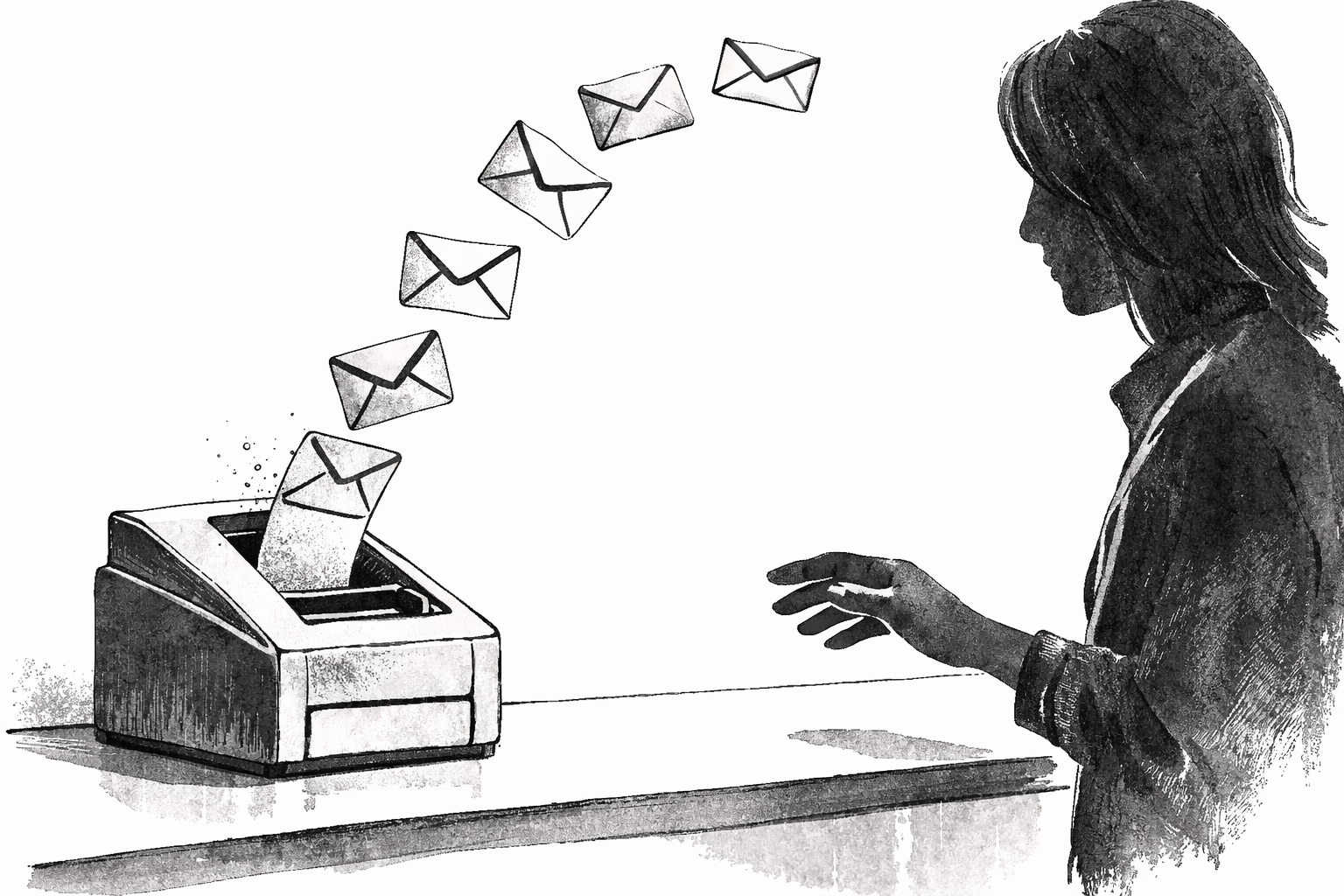
What a simple request for a digital receipt reveals about marketing, data, and consent
I am not, by nature, a shopper. The word itself – with its implications of browsing without purpose and surrendering myself to the controlled chaos of retail – makes me slightly queasy. I am an introvert in the truest sense, and the ad-hoc interactions that shopping demands, the cheerful ambushes of strangers asking whether I need help, the general background noise, none of this is my natural habitat. I go to shops when I must, and I am relieved when I leave.
A couple of weeks ago, however, I had good reason to make an exception. I was hosting family visiting from France, and hospitality, as anyone who has ever welcomed guests from across the Channel will know, carries its own quiet obligations. And so I found myself in a small English market town – the kind that England does so well. It was genuinely charming, but I was still glad when it was over.
One of the shops we visited was part of a chain – one I know well, and from which I buy regularly online, happily and without complaint. In person, it was perfectly pleasant. But it was there, at the end of a transaction, that I heard something that stopped me. The shop assistant asked for an email address so that a digital receipt could be sent. The justification was immediate and smoothly delivered: it was, she explained, better for the environment.
I stood there in stunned silence for a moment. Better for the environment.
Now, I have spent the better part of thirty years in technology marketing, and nearly half of that working in cybersecurity. I have spent a good deal of time thinking seriously about what personal data actually is, what it is worth, and how easily it can be mishandled. An email address is not a trivial thing. In security terms, it is a point of entry. In marketing terms – my terms – it is a privilege.
So when I heard that email address requested at the till, dressed up in the language of environmental responsibility, something in me raised an eyebrow. Quietly. But quite firmly.
A digital receipt does use fewer physical resources than a printed one. OK, I will “buy” that argument. But to suggest that environmental concern is the reason behind the request is, to put it generously, a considerable stretch. What sits at the heart of the request is a marketing list. What is being built, one transaction at a time, is a database. The environmental framing is not the reason for asking. It is the reason selected because it is the one most likely to work – and in an age when environmental virtue has become a form of social currency, it is, I will admit, rather well chosen.
I say none of this to be hard on the shop assistant, who was perfectly pleasant and simply doing her job. I say it because I think it is worth being clear-eyed about what is actually happening in these moments. Data is being collected. The person being asked almost certainly has no clear picture of what will happen to that information once the transaction is complete. There was no mention of how the address would be stored, what it would be used for beyond the receipt, how long it would be kept, or what one might do if one would simply prefer not to receive emails. These are not bureaucratic formalities; they are the minimum that consent requires.
The family member I was with declined, pleasantly but without hesitation. I was very pleased about that.
I have been a marketer long enough to understand the pressures that produce these practices. Building an engaged audience is genuinely hard work. Acquiring email addresses through paid channels is expensive. Organic growth is slow and frequently humbling. The temptation to collect data at every available touchpoint is, from a purely commercial standpoint, entirely rational. I understand the logic and I have lived inside it for decades.
But understanding something and endorsing it are not the same thing. What troubled me in that shop was not the ambition – every marketer wants to grow their list, and there is nothing wrong with that – but the method. An email address should be earned. It should be the result of a genuine value exchange, honestly described and freely given. When it is obtained instead through a framing that is, at best, incomplete, something small but consequential has gone wrong.
The market town was lovely. The receipt, in the end, was printed.
Leave a Reply