
Who owns the thought?
I have been turning a particular question over in my mind for a little while now, although it was Substack’s recent announcement that finally persuaded me to put pen to paper. Their new feature allows readers to see whether an article was written by AI or by a human, and my immediate reaction was one of genuine approval. Not because I believe AI-generated writing is somehow inferior, but because I welcome anything that encourages greater transparency about the way we create and share ideas.
Perhaps that sounds surprising – especially coming from someone who uses artificial intelligence almost every day.
I was not the earliest adopter, not by any stretch, but I have become a firm advocate. AI has transformed the way I research unfamiliar subjects, gather different perspectives, test assumptions and organise ideas that are still forming in my mind. Like many people, I have discovered that it is capable of accelerating tasks that once consumed hours, sometimes days, of work. It’s also allowed me to complete many a project that would otherwise have sat gathering dust in a drawer. Used well, it is an extraordinary companion for anyone whose profession revolves around ideas.
So why do I feel increasingly so uneasy? I am not worried about what AI can write, or whether we use it to aid writing, but about what we might actually stop doing ourselves. This has little to do with the technology itself and everything to do with thinking.
My perspective is undoubtedly coloured by the fact that I have loved language for as long as I can remember. I have written poetry since childhood and, although my professional life is now dominated by prose, poetry remains my first love. There is something profoundly moving about the way a handful of carefully chosen words can illuminate an idea, capture a feeling or reveal a truth that hundreds of perfectly competent sentences never quite reach. I have never regarded writing as merely a means of communication. At its best, it is an art form, one capable of carrying not only information, but memory, imagination and something of the person who wrote it.
Only a few days ago, my husband and I bought a Pierre de Ronsard rose for our garden. Before it had even found its place in the flowerbed, I found myself reciting the opening lines of Ode à Cassandre: “Mignonne, allons voir si la rose”… It was an entirely instinctive response. The rose evoked the poem; the poem evoked memories stretching back many years. That chain of association could never have been planned. It was simply the accumulated residue of a lifetime spent reading, writing and loving language.It also reminded me that writing is about far more than arranging words in the right order. Writing is where memory, experience, curiosity and reflection meet. Which brings me neatly to my next point.
The confidence to think out loud
Over the past few months, I have read comments on LinkedIn that leave me genuinely perplexed. Each sentence, taken on its own, seems perfectly reasonable. The grammar is faultless, the vocabulary polished, and the tone suitably upbeat. Yet, by the end, I realise I have learned nothing at all. There is no clear opinion, no argument, and certainly no perspective that could only belong to another person. The words look meaningful, but somehow manage to say nothing. The only description I feel is appropriate for this odd phenomenon is “word salad”.
I found these to be mildly irritating at first. Surely, I am worth more than just an AI-generated comment? But talking this through with colleagues and friends, I began to wonder if these comments were less about laziness and more about something a little sadder: a growing lack of confidence in our own voices.
I also wonder whether the environment we have created online bears some responsibility for that. Social media can be an unforgiving place in which to think out loud. There was a time when it felt possible to explore an idea, to test a hypothesis or even to change one’s mind in public. Today, however, the cost of expressing an imperfectly formed thought can feel disproportionately high. We have become accustomed to seeing people criticised, sometimes mercilessly, for choosing the wrong word, asking the wrong question or holding an unfashionable opinion. In such an environment, it is hardly surprising that many people reach for the apparent safety of AI.
After all, AI is remarkably good at producing prose that is hard to object to. It smooths away the rough edges, tempers conviction, removes ambiguity and delivers something polished, balanced and safely inoffensive. Yet, in protecting us from criticism, it often shields us from something else as well: personality, individuality, conviction. We become so careful not to say the wrong thing that we end up saying almost nothing. It lets people appear to engage, without actually saying anything.
Authenticity has always required a degree of vulnerability. The moment we express a genuinely original thought, we expose ourselves to disagreement. That has always been the price of authorship. AI offers us an escape from that discomfort, but I cannot help wondering whether, in avoiding the risk of being criticised, we also avoid the possibility of saying something memorable.
Human Writing versus Authentic Writing
The more I think about this, the more convinced I am that we need a richer vocabulary for talking about writing in the age of AI. We tend to ask whether something was written by a human or written by artificial intelligence, as though those were the only two possibilities, but I no longer think they are.
Increasingly, I find myself distinguishing between what I would call Human Writing and Authentic Writing.
Human Writing is perhaps the easier of the two to describe. Every word, every edit and every revision originates entirely with the author. No AI has suggested a phrase, corrected a sentence or reorganised a paragraph. Until very recently, this was simply what we meant by writing, and there will always be enormous value in preserving that discipline. There is something deeply satisfying about wrestling alone with language until it finally yields the sentence you had been searching for.
Authentic Writing, as I see it, is different.
It is entirely possible to use AI and still produce work that is unquestionably authentic.
If I ask AI to summarise research, suggest a clearer structure, identify weaknesses in my argument or help me untangle an awkward sentence, I have no difficulty acknowledging its contribution. In many respects, that is no different from discussing an article with a trusted colleague, debating an idea over dinner or asking an editor to challenge my reasoning. The thinking remains mine, so are the conclusions. AI has simply helped me to articulate them more clearly.For me, authenticity has very little to do with who typed the words, but it has everything to do with who owns the thought.
Research is not thinking
Research and thinking have never been the same activity. After all, in science, it is perfectly acceptable to have a whole team working behind the scenes on research. Yet it is becoming easier to confuse the two. One gathers information; the other turns information into judgement. Between those two stages lies something wonderfully untidy: reflection, uncertainty, lived experience, changing one’s mind, abandoning one argument for another, and sometimes discovering that the question itself is more interesting than the answer.
That’s the whole point of the process. This is where we learn and get better. It is also the part that cannot be outsourced without losing something essential.
None of this should be mistaken for a rejection of AI. On the contrary, I believe artificial intelligence is one of the most powerful intellectual tools humanity has ever created. It can expose us to unfamiliar perspectives, challenge assumptions we did not know we held and accelerate learning in ways that would have seemed almost miraculous only a few years ago. Whether it helps us become better thinkers depends entirely on how we choose to use it.
Presence over perfection
That is the question I now find myself asking whenever I read something online. I am far less interested in whether AI played a part in producing the prose than I am in whether I can sense another human mind behind it. Is there a genuine curiosity at work? An original insight? A conclusion that has obviously been wrestled with rather than copied and pasted? Has the writer left something of themselves on the page?
Because that, ultimately, is what I think readers are searching for. Not perfection, but presence.
Not flawless prose, but the unmistakable feeling that another person has done the difficult work of thinking and has been generous enough to share the journey, not merely the destination.
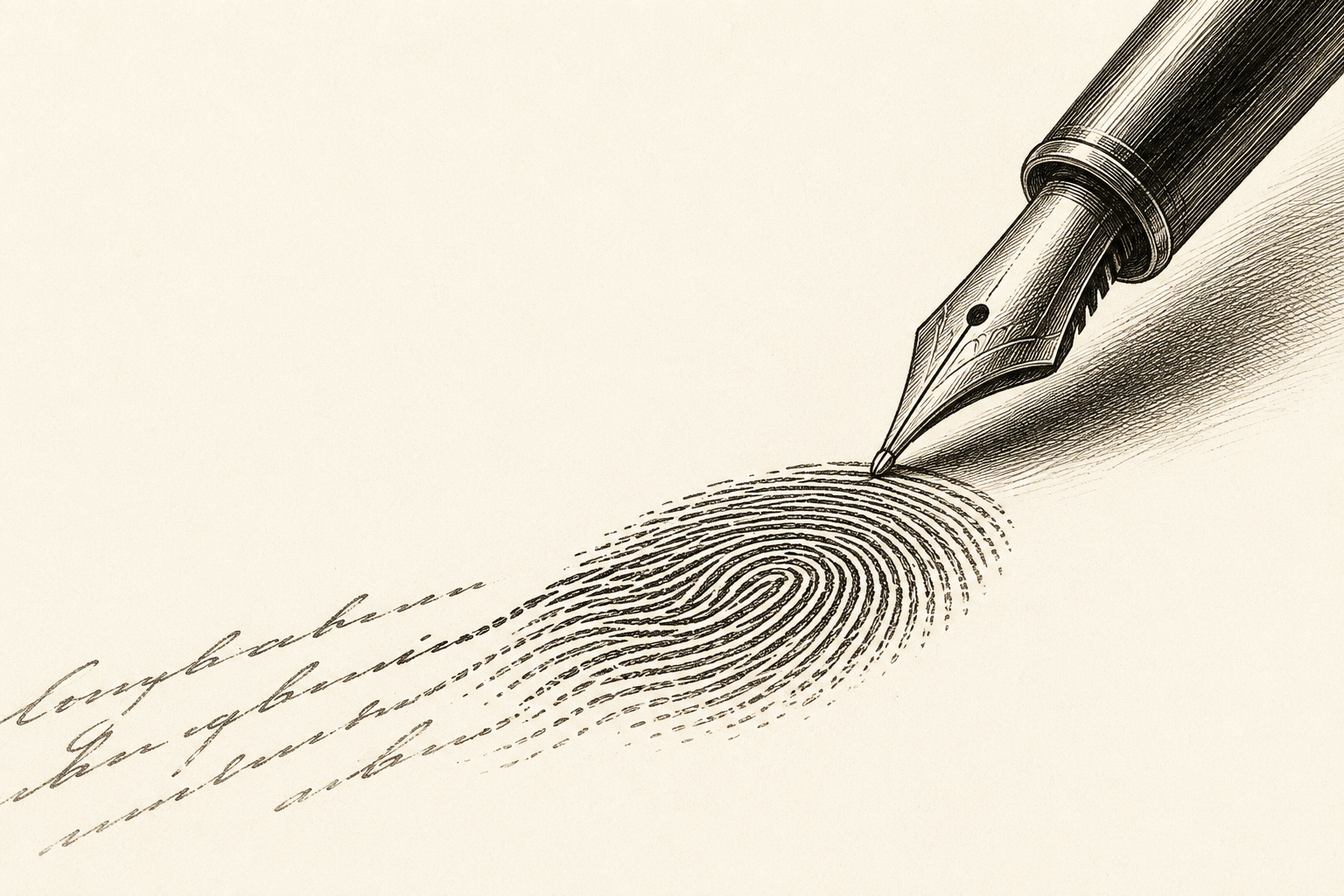
For me, that is what Authentic Writing has come to mean. It is not writing untouched by technology, nor is it writing produced in splendid isolation. It is writing that still bears the fingerprints of the person who created it. Writing whose ideas have been earned rather than generated. Writing that reminds us that while technology will continue to change beyond recognition, the most valuable thing any writer has to offer remains exactly what it has always been: an original mind, honestly expressed.
Leave a Reply