
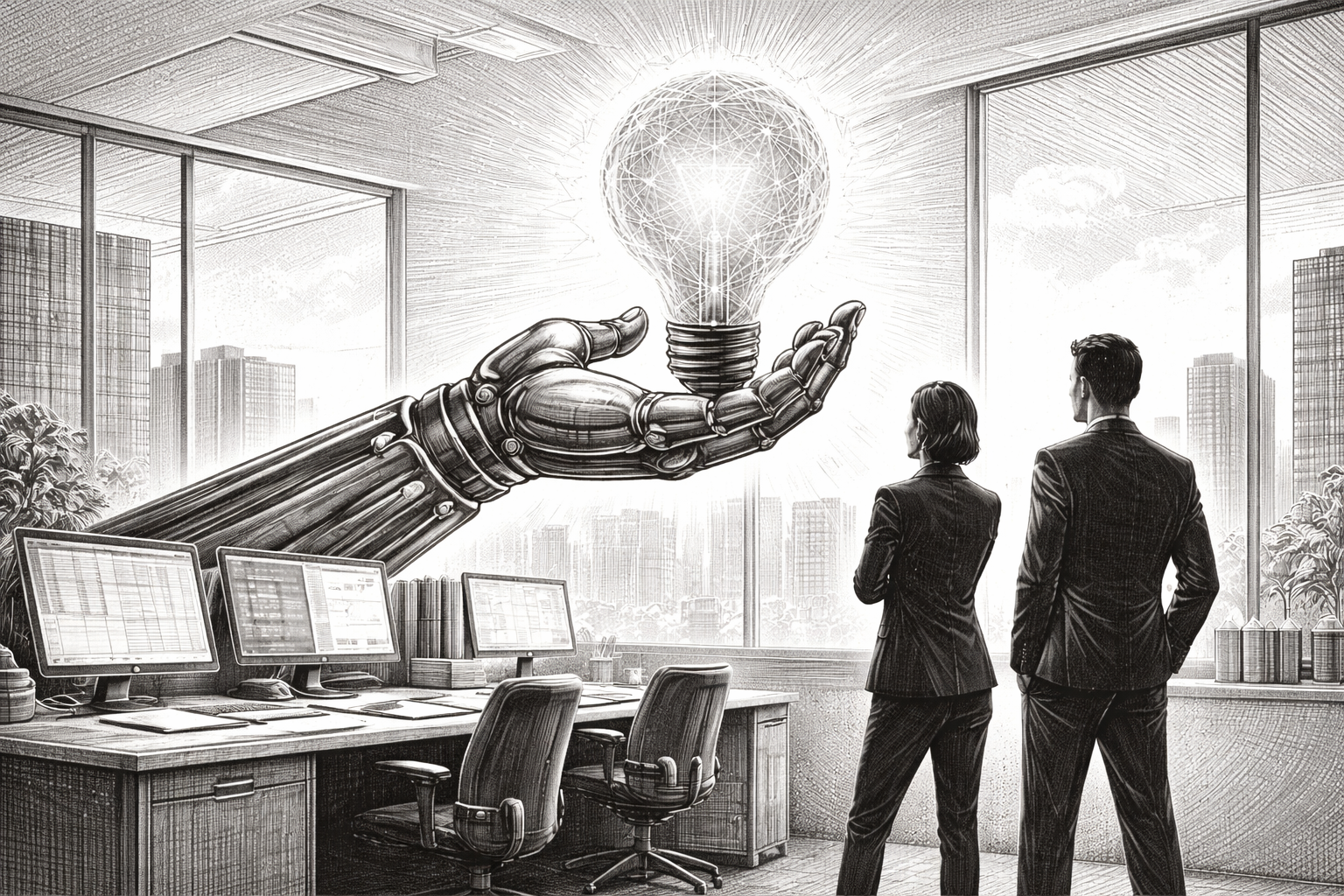
This is a personal perspective on how marketing leaders are navigating the rise of AI in their field: balancing the pressures of productivity, the undercurrent of fear, and the genuine opportunity to create work that is not only better, but also more human.
When I think about the way AI has entered marketing teams over the past few years, the word that comes to mind first is pressure.
There is pressure to adopt AI, to experiment with it, and to demonstrate that one is not falling behind.
For many CMOs, myself included, AI was initially presented as a productivity tool: something designed to deliver content more quickly, increase output, reduce costs, and improve efficiency.
This perspective on AI was, in equal measure, helpful and unsettling.
It was helpful in that it gave AI a clear and rational place within the organisation; yet it was unsettling, as it prompted uncomfortable questions about creativity, differentiation, credibility, and, at a more fundamental level, about people themselves.
This concern extends beyond writers or content creators to include marketers, analysts, designers, and strategists. For many, the arrival of AI brought with it a quiet yet persistent anxiety about what it might mean for their roles, their relevance, or even their jobs. So much has been written, and indeed whispered, about entire professions vanishing that it would be naïve to ignore the human impact of such a narrative.
If everyone is using the same tools, the question becomes: how does one avoid sameness, prevent the so-called ‘AI slop’, and protect the qualities that make a brand distinctive?
I believe this tension explains why so many teams have approached AI with caution, and at times, even defensiveness.
Focusing on productivity provided the safest entry point; it bought valuable time to test, to learn, and to understand where the real risks and opportunities might lie.
But I don’t believe productivity is the end of the story.
In fact, some of the clearest indications that we are entering a new phase have come from outside marketing teams altogether. Observing how AI companies chose to present themselves in this year’s Super Bowl advertisements,
with a focus less on features and more on trust, values, and human context, reinforced for me that this shift is cultural as much as it is technological.
What genuinely excites me is the possibility that AI could help marketing become not only faster, but better, provided we anchor its use in a clear understanding of brand and values.
For me, the real question is not ‘How much can AI do?’ but rather, ‘What should it be doing on behalf of this brand?’
When teams begin from this standpoint, the conversation shifts: AI becomes less about replacing creativity and more about supporting it; less about volume and more about coherence; less about automation and more about consistency.
I am increasingly convinced that AI is most effective when it is guided by a strong sense of identity—when it reflects a brand that already understands who it is, what it believes, and how it wishes to present itself to the world.
When used in this way, AI can help marketing teams to:
- show up more consistently across touchpoints
- communicate with more relevance and clarity
- free up time for deeper thinking rather than more output
Of course, this does not mean that the risks vanish. Poorly used AI will, without doubt, produce bland and generic work. Yet this is not a new phenomenon; tools have never compensated for a lack of direction.
What feels different now is that the opportunity is coming into sharper focus.
If we shift our focus away from features, and even from productivity, and return to values, meaning, and human connection, AI becomes an amplifier rather than a threat.
For CMOs, the opportunity now is not to ask how quickly AI can make marketing teams work, but rather how clearly it can help them express who they are. When AI is anchored in identity and values, it ceases to flatten brands and instead helps to sharpen them.
I do not see this next phase as something to be feared.
Rather, I see it as an opportunity for marketing to become more intentional, more human, and more closely aligned with the genuine value our businesses seek to deliver.
Leave a Reply